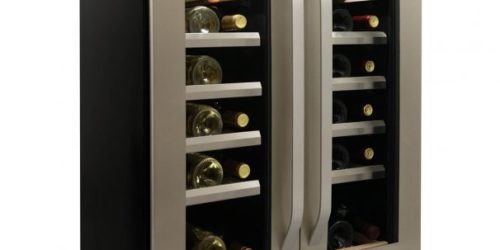
Best Wine Coolers Of 2024
There are few moments sweeter than getting home from work, kicking off your shoes, turning on your latest Netflix addiction, and sipping on a glass of wine. Seriously, is there anything more relaxing after a long day?
But maybe that’s not your style. Maybe you take your wine a little more seriously. Maybe you respect the wine. You know: swirl it around the glass a few times, give it a good sniff, savor the aromas, conjecture about the flavor profile… all before taking that first beautiful sip. That’s cool too. Especially when they’re in one of the best red wine glasses.
Wine is a versatile beverage. It fits in at a fancy dinner, at girls’ night, and at your latest TV show binge session. That’s why we love it. It appeals to almost everyone and enhances just about every situation. Wouldn’t it be important, then, to make sure your wine experience is as perfect as possible?
Sure, maybe you bought the $12 bottle from the local grocery store. Who cares! That wine needs to be properly stored, cooled, and ready to go when it’s called upon. That’s where the best wine coolers on the market come in.
In fact, you shouldn’t even refer to your wine fridge as a mini wine fridge, a wine cabinet, a wine cooler, or any other common name. That thermoelectric wine cooler is not an appliance. It’s a friend. It has your back and it won’t let you down when the boss comes over for dinner or when you need a little stress relief because of that very same boss.
So, without further ado, let us introduce you to your new best friends. The best wine coolers from the best wine cooler brands in the game.
Best Wine Coolers In 2024
EdgeStar CWR531SZ – Best Under Counter Wine Cooler
[easyazon_image align=”none” height=”500″ identifier=”B007KIGNTM” locale=”US” src=”https://images-na.ssl-images-amazon.com/images/I/51VzkiQy8IL.jpg” tag=”12×75-20″ width=”500″]
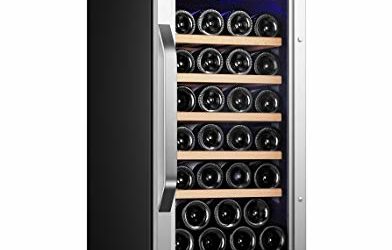
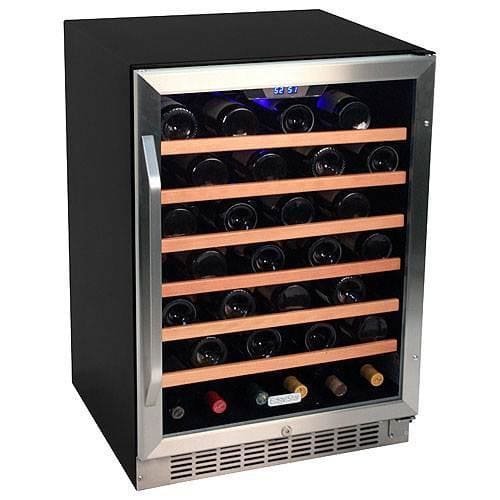
Can you go wrong with the classic pairing of black and stainless steel? Absolutely not. From the very first moment you lay eyes on the EdgeStar CWR531SZ, you’ll be in love. This is one of the best under counter wine refrigerators you can buy, and as an added bonus, it can also be used freestanding.
Open the tinted glass door and you’ll be even more impressed. The slide-out shelves are trimmed in wood and practically scream class. It doesn’t stop there—blue accent lighting illuminates the interior, providing a tempting aura that beckons your eyes almost as much as the wine it highlights tempts your taste buds.
From its aesthetic appeal to the pristine condition and temperature it keeps your wine in, the EdgeStar CWR531SZ is truly one of the best wine refrigerators you can buy. To learn more about this brand, check out our piece on the best EdgeStar wine coolers on the market.
Whynter BWR-18SD – Best Sleek Wine Cooler
[easyazon_image align=”none” height=”500″ identifier=”B004HXDLJ8″ locale=”US” src=”https://images-na.ssl-images-amazon.com/images/I/41ALSc%2BkqCL.jpg” tag=”12×75-20″ width=”500″]
Grab the closest dictionary you can find. Got it? Good. Now flip to “Sleek.” Do you see it? That’s right, it’s a picture of the Whynter BWR-18SD. Pretty cool, right?
We could stop there. That’s how good this thing looks with its slender profile, smooth black body, and stainless-steel face. Lucky for you, this gorgeous wine cooler is also a damn good one. With digital LED control and powerful fan-driven cooling to ensure the perfect wine storage temperature, the Whynter BWR-18SD keeps your wine tasting as good as the wine cabinet holding it.
Kalamera 157 – Best Wine Cooler
[easyazon_image align=”none” height=”500″ identifier=”B01I1CNU5A” locale=”US” src=”https://images-na.ssl-images-amazon.com/images/I/417Ae5LQA6L.jpg” tag=”12×75-20″ width=”500″]
This product takes the beauty and the beast and turns them into one massive explosion of pure magic. We’re not exaggerating. This thing is huge, but also elegant. It will be a main feature of any room it inhabits, but will also blend in to sophisticated interior design.
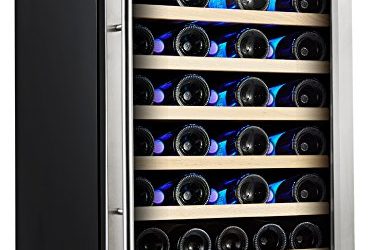
Its door features stainless steel and triple-layered tempered glass that is guaranteed to look fantastic while keeping the wine inside protected from any outside elements. The blue LED lighting provides a soft glow that tempts without overpowering, perfectly complimenting the removeable beechwood racks.
Perhaps the most surprising part of this incredible wine refrigerator is just how efficient it is. Seriously, if it wasn’t so gorgeous, you may not even realize it was in the room. In fact, it’s one of the best quiet wine coolers on the market.
As if everything we’ve mentioned wasn’t enough, the Kalamera 157 also offers dual-zone climate control. If you’re a wine expert, you know the advantages of this, but we’ll explain it briefly anyway. Different wines require different chilling temperatures. By not limiting yourself to one temperature for the whole wine cooler, you are able to provide the best environment for the variety of wines you enjoy!
Magic Chef MCWC12 – Best 12 Bottle Wine Cooler
[easyazon_image align=”none” height=”500″ identifier=”B00IID3OZE” locale=”US” src=”https://images-na.ssl-images-amazon.com/images/I/41dmP6AWFgL.jpg” tag=”12×75-20″ width=”500″]
This 12-bottle wine refrigerator makes the list for several reasons, not the least of which is its convenience. It’s relatively simple, but everything it does, it does well.
Many people don’t need to have more than 12 bottles of wine on tap at one time. That’s where a wine cabinet like the Magic Chef MCWC12 comes into the picture. From a size perspective, it just makes sense. It does a fantastic job of chilling a suitable quantity of wine without taking up a large amount of space.
In its compact package it packs an LED display to prominently show the temperature at which the wines are being stored. It also happens to be one of the best quiet wine coolers out there. If you’re looking for something utilitarian that looks nice, but not over the top, and performs the job it was built to perform, this is one of your best options.
Koldfront TWR247ESS24 – Best Thermoelectric Wine Cooler
[easyazon_image align=”none” height=”500″ identifier=”B00AMFLZLG” locale=”US” src=”https://images-na.ssl-images-amazon.com/images/I/414s1rm%2BXIL.jpg” tag=”12×75-20″ width=”500″]
This freestanding product is by far on of the best thermoelectric wine coolers on the market. Why? Start by looking at it! The tempered glass door is large and inviting, showing off the wooden shelves and your finest collection of wines.
The blending of aesthetics and functionality is what truly sets the Koldfront TWR247ESS24 apart. The upper and lower climate zones are divided by a visually-pleasing set of controls and LED temperature gauges that are clearly visible through the glass front. The mixture of elements—wood, steel, and electronic blues—adds a classy feature to any room without being too gaudy.
If you’re in the market for a high-capacity wine fridge that is good-looking and efficient, this might just be the cooler for you. Heck, we’d be proud to have this featured in our kitchen!
Ivation 18 – Best Elegant Wine Cooler
[easyazon_image align=”none” height=”500″ identifier=”B01NACAIVK” locale=”US” src=”https://images-na.ssl-images-amazon.com/images/I/41%2B2C25flDL.jpg” tag=”12×75-20″ width=”500″]
We know what you’re thinking—where’s the stainless steel? Sorry, none of that here. Instead, we have a smooth modern thermoelectric wine cooler that stands out in just how well it fits in.
The Ivation 18 is all about consistent temperature control and sleek modern aesthetics. Sounds great in theory, doesn’t it? You’ll be happy to know that it executes both of those goals to absolute perfection. With exterior touch controls to compliment the LCD temperature display, every element of this particularly quiet wine refrigerator flows seamlessly into the next.
Sure, it may not be the fanciest looking wine cabinet. It may not draw gasps of awe from your dinner guests. Personally, we think this can be a good thing. Sometimes less is more, and the Ivation 18 is one of the best examples of minimalism being not only functional, but beautiful.
From the black exterior to the tinted glass, each aspect of this fridge serves a purpose without interrupting the cohesion of the design. It’s truly a masterpiece in form meeting function.
Danby 36 – Cool Wine Fridge
[easyazon_image align=”none” height=”500″ identifier=”B007PKOMWU” locale=”US” src=”https://images-na.ssl-images-amazon.com/images/I/41SQuGKeEPL.jpg” tag=”12×75-20″ width=”372″]
This is another example of the best wine coolers taking functionality, minimalism, and attractively sleek looks and incorporating them into a product that not only looks good, but performs at an exceptional level.
From the handle recessed into the stainless steel trim to the alluring blue LED lighting that emanates from the tempered glass door, the Danby 36 is an exercise in subtlety. It looks great without being overwhelming—a valuable trait for many consumers who want a wine cooler that is aesthetically-pleasing without being over-the-top.
One cool feature that we love about the Danby 36 is the door that can be opened from either side. How neat is that? But it’s not just a party trick, it’s actually extremely convenient. Depending on where you will be placing the refrigerator, the direction that the door opens can become an issue. Not with this handy reversible swinging door! To read more about this brand, check out our post on the best Danby wine coolers in the market today.
Choosing the Best Cooler for You
There you have it—the best wine coolers available. Armed with this invaluable information, we set you off into the world (or the internet, let’s be honest) to select the fridge that will work best for you. And remember you can learn even more here about the different types of wine fridges that exist.
In case you’re still slightly overwhelmed by the options and possibilities (despite our insanely helpful and well-written list), let us leave you with a final piece of advice: choose the option that best fits your needs.
What do we mean by that? Basically, don’t buy that beautiful wine fridge that can hold 1,000 bottles and is also a transformer unless you actually need and will use the beautiful 1,000-bottle fridge that’s also a transformer. Or do, it’s your life and your wine, and you know what? Both deserve the very best.