Types of Wine Fridges | The Complete Guide to Choosing One

types of wine fridges

12×75 Buying Guide
Types Of Wine Fridges That Will Keep Your Wine Happy
The labels overlap on purpose, and the marketing likes it that way. Once you see that a wine fridge is really four separate decisions, the whole confusing category falls into place.

The Quick Answer

A “type” of wine fridge is really four choices stacked on top of each other: where it goes (freestanding, built-in, integrated, countertop, full-height, side-by-side), how many temperature zones it has (single, dual, multi), how it cools (compressor or thermoelectric), and what it is for (long-term ageing, serving, or just chilling drinks). One fridge can be built-in, dual-zone and compressor-cooled all at once, which is why the labels seem to contradict each other.

For most people ageing a mixed collection, a single-zone compressor cabinet held at a steady 12C is ideal. Multiple zones matter for serving different styles at the right temperature, not for storing reds and whites apart. That last sentence saves you a lot of money, so we will come back to it.

The One Idea

Stop thinking about “types”. Think about four decisions

The reason shopping for a wine fridge feels like wading through treacle is that the industry describes the same appliance in four different languages at once. A listing will call something a “built-in dual-zone compressor wine cellar” and expect you to know which words matter. They all do, but they answer completely different questions, and muddling them is how people end up with the wrong fridge in the wrong place doing the wrong job.

So ignore the marketing nouns for a moment. Every wine fridge is the sum of four independent decisions: where in your home it physically lives, how many separate temperatures it can hold, what kind of cooling engine it uses, and whether its actual purpose is ageing wine for years, serving it this weekend, or just keeping cans cold. Get those four right, in that order, and the perfect fridge more or less selects itself. Get them muddled and you will pay for features you do not need while missing the one that matters. Let us take them one at a time.

wine fridges

Decision One

Where it goes: installation type

This is the decision that will physically stop your fridge from working if you get it wrong, so it comes first. The critical concept is venting. Every wine fridge has to dump heat somewhere, and where it dumps it decides where the fridge can live.

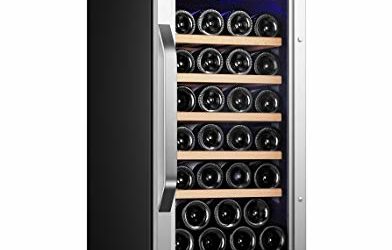
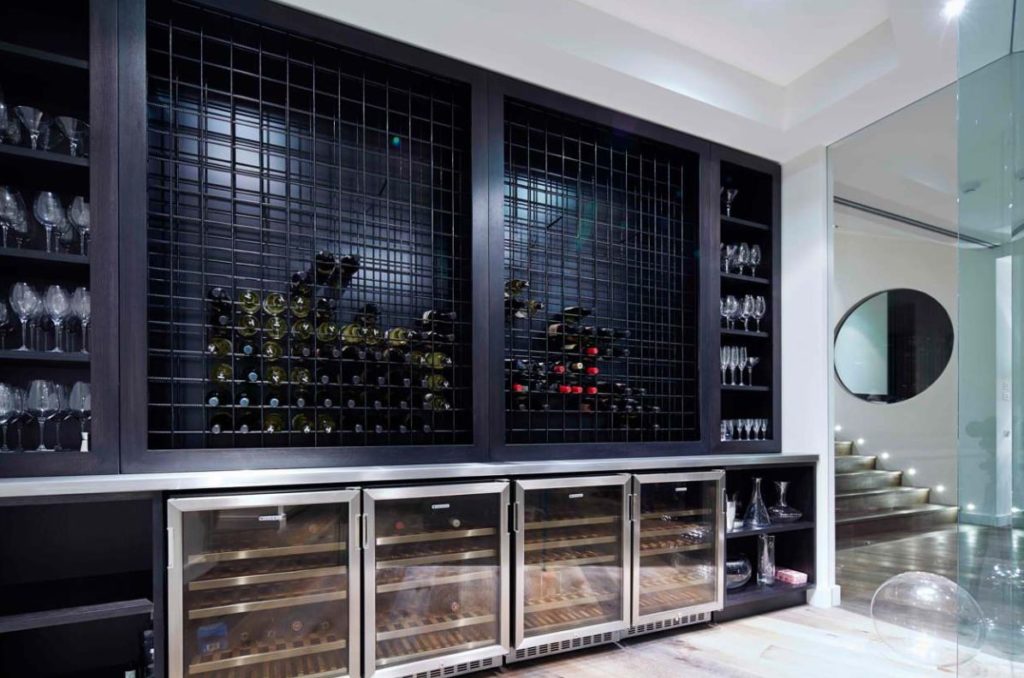
Freestanding units vent from the back or sides, so they need breathing room around them and must never be boxed into a tight cabinet, or they cook themselves and fail early. Built-in or under-counter units vent from the front, usually through a grille at the bottom, which is precisely what lets them slot flush under a worktop or into a run of units. This front-versus-rear venting distinction is the single most common installation mistake, so if you are building it in, the box must say “built-in” or “front-venting”, full stop. Fully integrated models go a step further and hide behind a cabinet door or matching panel so the kitchen looks seamless. Countertop units are the small ones, roughly six to eighteen bottles, that sit on a worksurface for a handful of bottles you are drinking soon. Full-height cabinets are the serious storage towers, often holding well over a hundred bottles. And side-by-side designs are essentially two cabinets in one shell, frequently with independent zones, for people who want a lot of wine at more than one temperature.

Type Where it goes Vents from Typical capacity Best for
Freestanding Open floor or gap with clearance Rear/sides 20 to 200+ Flexibility, most capacity per pound
Built-in / under-counter Flush under a worktop or in units Front 20 to 50 Fitted kitchens, tidy installs
Fully integrated Behind a cabinet door or panel Front 20 to 50 Seamless, hidden kitchen looks
Countertop On a worksurface Rear 6 to 18 A few bottles ready to drink
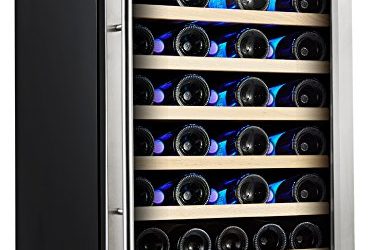
Full-height Freestanding or built-in tower Varies 100 to 300+ Serious collections and ageing
Side-by-side Wide gap, usually built-in Front Large, split Lots of wine at two temperatures

Decision Two

How many zones: and the myth that sells you extra ones

Here is where the industry makes a lot of its money, so pay attention. A single-zone fridge holds one temperature throughout. A dual-zone fridge has two independently controlled compartments, and a multi-zone fridge has three or more. The sales pitch is always the same: reds and whites need different temperatures, so you need at least two zones. It is half true, and the untrue half is the expensive half.

The myth worth busting is that reds and whites must be stored separately. They do not. For long-term ageing, almost all wine, red, white, sparkling, sweet, is perfectly happy resting at a single steady cellar temperature of around 12C. A traditional underground cellar is one temperature, and it has aged the world’s greatest bottles for centuries without once sorting them by colour. If your goal is to lay wine down and let it mature, a good single-zone cabinet is not a compromise. It is the classic, correct answer.

So what are the extra zones actually for? Serving temperature. A wine tastes best served in a fairly narrow band: roughly 6 to 8C for Champagne and sparkling, 8 to 12C for whites and rose, and 14 to 18C for reds. If you want to pull a white and a red from the same fridge and have both ready to pour at their ideal drinking temperature, then two zones genuinely help. That is a serving convenience, not a storage requirement. Decide honestly which you are doing. If you are ageing, one zone is fine. If you are running a mini bar of ready-to-drink bottles, pay for the second zone. Our guide to wine serving temperatures has the full range if you want to set your zones properly.

Decision Three

How it cools: compressor versus thermoelectric

Two technologies do the actual chilling, and the choice matters more than the spec sheet lets on. Compressor cooling is the same principle as your kitchen fridge: a proper refrigeration cycle. It is powerful, holds temperature reliably even when the room is warm, reaches colder settings, and scales to large cabinets. The trade-offs are that it hums, and it vibrates, because there is a motor cycling on and off. Good cabinets manage both with insulation and anti-vibration mounts, but a cheap one can buzz and shudder.

Thermoelectric cooling uses the Peltier effect, passing a current across a plate to move heat with no moving compressor. The upside is lovely: near silent, almost no vibration, which sounds perfect for wine. The catch is power. Thermoelectric units can only pull the interior roughly 10 to 15C below room temperature, they struggle in warm or fluctuating rooms, and they do not scale, so they are confined to small countertop sizes. In a cool, stable room with a dozen bottles they are excellent. In a warm kitchen or a collection of any size, they quietly fail to hold temperature. As a rule: thermoelectric for small, quiet and cool; compressor for serious, large or anywhere the room gets warm.

Decision Four

What it is for: cabinet, serving fridge or beverage cooler

This is the decision buyers skip, and it is the one that ruins wine. Three appliances get sold under overlapping names, and they are not interchangeable. A storage or ageing cabinet is built to hold one stable temperature for years, with humidity control to stop corks drying out, UV protection, and low vibration. This is what you want if you are laying wine down. A serving fridge is designed to bring wines to drinking temperature, usually with multiple zones, and is optimised for convenience rather than decades of ageing. An ordinary beverage cooler is the impostor: it chills anything, cans, water, wine, but it runs colder than wine wants, controls no humidity, and is not built for ageing at all. It is fine for bottles you will drink within weeks. Put a case of Barolo in one for five years and you will be disappointed, because the dry air will shrink the corks and let the wine oxidise. Match the machine to the mission.

The Small Print

The specs that quietly decide everything

Once the four big decisions are made, a handful of unglamorous specifications separate a fridge that protects your wine from one that slowly wrecks it. Ventilation and clearance come first, as covered above: block the vents and the unit overheats. Ambient room temperature is the silent killer, because every fridge has a rated operating range and will not hold its setting if the room drifts outside it. Noise and vibration matter both for your sanity and, over long ageing, for the wine, since constant vibration is thought to disturb a wine’s slow development. UV protection is why serious cabinets use tinted, treated glass or solid doors, as light degrades wine faster than almost anything. Humidity should sit around 50 to 70 percent to keep corks supple, which cheap beverage coolers ignore entirely. And the quiet luxuries earn their place too: a lock for valuable bottles, a temperature and door-ajar alarm so you know the instant something is wrong, and power-cut recovery so the unit returns to your settings after an outage rather than sulking at the wrong temperature. None of these make the advert. All of them decide whether your wine survives.

A cautionary tale: the tailor and the 1cm gap

If you think this stuff is fussy, consider the case currently in a London court. Tom Reimer, a millionaire tailor who once made Luciano Pavarotti’s white silk tailcoats, is suing a refrigeration supplier for more than 550,000 pounds. He alleges that three bespoke wine cabinets fitted in his Marylebone flat in 2021 had a gap of around one centimetre running the height of the sliding doors, which let warm, humid air in and caused condensation and mould to attack the labels of roughly 1,500 bottles, including rare Chateau Mouton Rothschild and Petrus. Damaged labels alone, the claim runs, knocked around 500,000 pounds off the collection’s value.

The supplier denies it, arguing the gap met industry standards and that Reimer himself switched the units off to quiet the noise from the condensers. The trial is ongoing, so nothing is proven either way. But as a free lesson in why door seals, humidity, ventilation and noise all belong on your checklist, you could not invent a better one. A wine fridge is only as good as its worst-fitted door.

The Capacity Lie

Why a “100-bottle” fridge holds nothing like 100 bottles

Every capacity figure you see is a best-case fantasy, and it is worth understanding the trick. Manufacturers count capacity using the slim standard Bordeaux bottle, because it is the narrowest common shape and lets them quote the biggest number. Real collections are not all Bordeaux. Burgundy and Pinot Noir bottles have wider shoulders, Champagne bottles are properly fat and heavy, and Rhone, dessert and novelty bottles come in every awkward size going. Fill a fridge with a realistic mix and you routinely lose 30 to 40 percent of the advertised capacity, because the fat bottles will not sit in the racks as tightly as the spec assumed. A quoted 100-bottle cabinet may hold 60 to 70 of your actual bottles, and fewer still if you love Champagne. Our explainer on Champagne bottle sizes shows just how much room the big formats devour.

Which leads straight to the other capacity mistake: buying for the collection you have rather than the one you are about to have. Collections grow, always faster than expected, and a wine fridge you fill on day one is a wine fridge you have outgrown by month three. Build in real headroom. A sensible rule is to take the honest, mixed-bottle capacity, not the Bordeaux fantasy, and then buy at least a third bigger again. You will use it. Nobody in the history of wine has ever complained about having too much cool, stable storage.

Location, Location

Why the garage is usually a trap

It seems so logical. The garage or the outbuilding is cool, out of the way, and has room for a big cabinet. It is also, for most of the year, the worst place you could pick. The problem is that rated ambient operating range again. A garage swings with the seasons, baking in summer and dropping near or below freezing in winter, and both extremes defeat a wine fridge. In summer heat, the cooling, especially thermoelectric, cannot keep up and the interior drifts warm. In winter cold, a compressor may barely cycle because it thinks the job is done, letting the wine sag toward the room’s temperature, and in a hard frost you risk the wine actually freezing and pushing the corks. Unheated, uninsulated spaces also tend to be damp, dusty and prone to big daily temperature swings, and swings are precisely what ageing wine hates most. Unless your garage is insulated and genuinely climate-stable all year, or the fridge is specifically rated for wide ambient ranges, keep the cabinet inside the heated envelope of the house.

The Shortcut

Which one should I buy?

Match your situation to the row and you have your answer, without reading another spec sheet.

If this is you Buy this
A few bottles ready to drink, small quiet kitchen Countertop thermoelectric, single or dual zone
Building a collection to age for years Full-height single-zone compressor cabinet, ~12C, with humidity and UV protection
You entertain and want reds and whites pour-ready Dual or multi-zone compressor serving fridge
Slotting it under a kitchen worktop Built-in / under-counter, front-venting, compressor
You want it invisible in the cabinetry Fully integrated model with a panel-ready door
Big mixed collection, warm-ish kitchen Full-height compressor, sized up for real mixed capacity

Avoid These

Common wine-fridge mistakes

Nearly every unhappy wine fridge story traces back to the same handful of errors. Building a freestanding, rear-venting unit into a tight cabinet so it overheats. Paying for dual zones to “separate reds and whites” when a single zone was always the right call for ageing. Buying a silent thermoelectric unit for a warm kitchen it can never cool. Trusting the Bordeaux-bottle capacity figure and running out of space almost immediately. Banishing the cabinet to a freezing or baking garage. Ageing wine long-term in a beverage cooler with no humidity control, so the corks dry and the wine oxidises. And setting a single-zone ageing cabinet to a chilly serving temperature, which is fine for drinking tonight but too cold for wine you mean to keep for a decade. Every one of these is avoidable the moment you separate the four decisions.

2026 Watch

The fridge that reads your labels

The newest development is the fridge that keeps your inventory for you. At CES 2026, Samsung unveiled a Bespoke AI Wine Cellar with vision-based AI built on Google Gemini. A camera at the top of the unit reads the label as you put a bottle in or take one out, logs it, and even records which shelf and compartment it went on, so you can find a specific bottle from your phone without rummaging. Through Samsung’s app it will look up wine information and suggest food pairings from whatever is actually in your inventory. The broader trend is furniture-like smart fridges that behave less like appliances and more like a butler with a spreadsheet.

It is genuinely clever, and worth a dose of 12×75 realism. Automatic inventory tracking solves a real irritation for anyone with more bottles than memory. But none of this changes the four decisions above. A smart fridge that logs your labels beautifully while sitting in a hot room with the vents blocked will still cook your wine, just with excellent record-keeping. The AI is a lovely extra on top of good refrigeration. It is not a substitute for it, and no amount of Gemini will un-oxidise a bottle. Buy the cooling first, and treat the cleverness as the garnish.

FAQ

Wine-fridge questions, answered

Can you store red and white wine in the same fridge?

Yes, easily. For ageing, red and white wine are both happy at one steady temperature of around 12C, so a single-zone fridge stores them together perfectly. You only need separate zones if you want each colour held at its different ideal serving temperature, ready to pour.

Do you really need a dual-zone wine fridge?

Only if you are serving. Dual zones let you keep whites at drinking temperature and reds slightly warmer at the same time. For long-term storage, a single zone at cellar temperature is the classic, correct choice, and often the better buy.

Is a compressor or thermoelectric wine fridge better?

It depends on size and room. Thermoelectric is near silent and vibration-free but only suits small units in cool, stable rooms. Compressor cooling is more powerful, reliable in warm rooms and scales to large cabinets, at the cost of some hum and vibration. For any serious storage, choose compressor.

Can I put a wine fridge in the garage?

Usually not, unless the garage is insulated and climate-stable year round, or the unit is specifically rated for wide ambient temperatures. Garages get too hot in summer and too cold in winter, both of which push the fridge outside its operating range and can even let wine freeze.

Why does my wine fridge hold fewer bottles than advertised?

Because the capacity is measured with slim standard Bordeaux bottles. Real bottles, especially fatter Burgundy and Champagne, take more room, so a realistic mixed collection commonly fills 30 to 40 percent less than the quoted figure. Always assume the true capacity is well below the headline number.

What temperature should a wine fridge be set to?

For long-term ageing, a steady 12C suits virtually all wine. For serving, aim for roughly 6 to 8C for sparkling, 8 to 12C for whites and rose, and 14 to 18C for reds. Stability matters more than hitting an exact number, so avoid constant adjustment.

Is a beverage cooler the same as a wine fridge?

No. A beverage cooler chills drinks but runs colder than wine likes and controls no humidity, so corks can dry out over time. It is fine for bottles you will drink within weeks, but it is not built for ageing wine. For anything you want to keep, buy a proper wine cabinet.

Sources and further reading: Samsung’s CES 2026 announcement of its Bespoke AI Wine Cellar, and reporting on the ongoing Tom Reimer wine-cabinet case, as covered by The Telegraph. If you are sizing a smaller setup, see our pick of countertop and small wine coolers, and if all this talk of Champagne has you thirsty, our best Champagne guide is right here. Wine is mostly water, but the calories in wine still count.

By Vim, Editor of 12×75.